
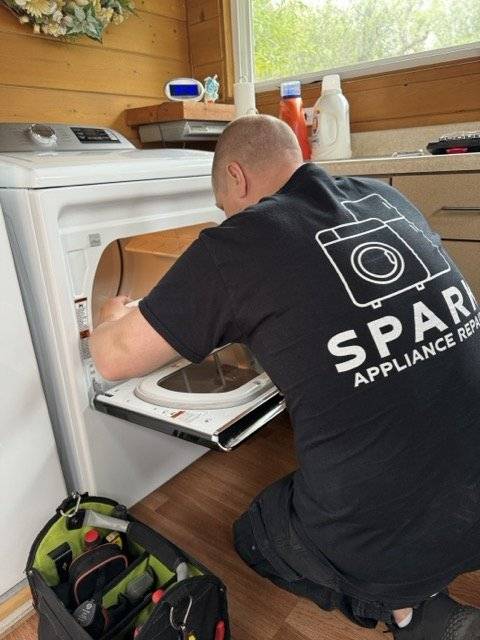
Few appliance problems are as stressful as opening your refrigerator to find that it’s no longer cold. Spoiled food, warm drinks, and a growing sense of panic — we’ve all been there. The good news: most refrigerator cooling problems have a clear cause and a straightforward fix.
Here are the seven most common reasons your refrigerator isn’t cooling, and what you can do about each one. These are the exact issues Yurii, our lead technician, encounters most often on service calls throughout San Diego County.
1. Dirty or Clogged Condenser Coils
This is the most common cause of a refrigerator that’s running but not cooling effectively. The condenser coils (usually located at the back or underneath the fridge) release heat from the refrigerant. When they’re coated in dust and debris, they can’t dissipate heat properly — and your fridge works harder while staying warmer.
What to do: Unplug the fridge, locate the coils, and vacuum them with a brush attachment. This simple maintenance step — done once or twice a year — can dramatically improve cooling performance.
2. Condenser Fan Motor Has Failed
If your condenser coils are clean but the fridge still isn’t cooling, the condenser fan motor may be to blame. This fan pulls air across the coils to help release heat. If it stops spinning, heat builds up and cooling efficiency drops sharply.
Signs of a failed fan: You may hear the compressor running but no fan noise. You might also notice the compressor cycling on and off more frequently.
What to do: This repair requires accessing the fan motor, testing it with a multimeter, and replacing it if it’s not running. A technician can typically handle this in under an hour.
3. Evaporator Fan Motor Failure
The evaporator fan circulates cold air from the freezer into the refrigerator compartment. If it fails, the freezer may stay cold while the fridge section warms up — a classic symptom.
What to do: Open the freezer and listen for the fan. If you don’t hear it running, the motor likely needs to be replaced. This is a common repair and typically costs $150–$250 including parts and labor.
4. Faulty Thermostat or Temperature Control
The thermostat tells the compressor when to kick on and off based on the set temperature. A malfunctioning thermostat may never signal the compressor to run — leaving your fridge warm even though everything else is working.
Simple test: Turn the thermostat to its highest setting. If the compressor doesn’t start, the thermostat is likely defective.
What to do: Thermostat replacement is a relatively affordable repair — usually $150–$200 with labor.
5. Refrigerant Leak
Refrigerant is the substance that actually makes your fridge cold. If there’s a leak in the sealed system, the refrigerant level drops and the fridge can no longer maintain proper temperatures. This is less common than other causes but does happen — especially in older units.
Signs of a refrigerant leak: The fridge runs constantly but never gets cold. You may also see frost buildup in unusual places, or hear a bubbling or hissing noise.
What to do: Refrigerant leaks must be repaired by a certified technician. In some cases — particularly if the compressor is also worn — it may be more cost-effective to replace the appliance.
6. Defrost System Malfunction
Modern refrigerators use an automatic defrost system to prevent frost from building up on the evaporator coils. If the defrost heater, defrost thermostat, or defrost timer fails, frost accumulates on the coils and eventually blocks airflow entirely — preventing cold air from circulating.
Signs of a defrost problem: You may notice frost buildup in the freezer, or the refrigerator getting progressively less cold over the course of several days before temporarily improving.
What to do: A technician can test each component of the defrost system individually and replace the faulty part. This is typically a $150–$250 repair.
7. Compressor Problems
The compressor is the heart of the refrigeration system. If it fails, the fridge simply cannot cool at all. Compressor issues are typically the most expensive refrigerator repair — and in some cases, may make replacement the better option.
Signs of compressor failure: The fridge makes a clicking noise every few minutes (the compressor trying and failing to start), or runs silently with no cooling at all.
What to do: Have a technician diagnose the compressor before assuming the worst. Sometimes the start relay — a small, inexpensive component — is the actual culprit rather than the compressor itself. A start relay replacement costs around $100–$150, compared to $300–$600 for a full compressor swap.
When to Call a Professional
Some refrigerator problems — like cleaning condenser coils or checking door gaskets — are straightforward DIY fixes. But most cooling issues involve electrical components, sealed refrigerant systems, or motor replacements that require professional tools and training. “A lot of homeowners lose $200–$400 worth of food before they call us,” says Yurii. “If your fridge is running but not cooling, call same day — most of these repairs take under two hours.”
If your refrigerator is less than 10 years old and the repair cost is under half the price of a new unit, repair is almost always the smarter choice financially.
Refrigerator Repair in San Diego
Spark Appliance Repair provides same-day refrigerator repair throughout San Diego County — including Chula Vista, El Cajon, La Mesa, Mira Mesa, Coronado, and more. We service all major brands: Samsung, LG, Whirlpool, GE, Bosch, Maytag, and others.
Call us at (619) 330-5105 or book online. We’ll diagnose the problem, give you an upfront quote, and get your refrigerator back to keeping things cold — usually on the same day.


