Gas and electric dryers make heat in completely different ways — answer one question and you’ve cut the suspect list in half.
The drum spins, the timer counts down — and the clothes come out cold and damp. A dryer that runs but won’t heat is one of the most common service calls we take across San Diego County, and the diagnosis splits cleanly down one line: is your dryer gas or electric? The two machines make heat in completely different ways, so they fail in different ways. Answer that one question and you’ve cut the suspect list in half.
Pick your path
BGas dryer trackIgniter, gas valve coils, flame sensor
CThe hidden root cause: your ventWhy thermal fuses keep blowing
DCosts & when to call$90 service call, credited toward the repair
First: is your dryer gas or electric?
Pull the dryer forward a few inches and look at what feeds it:
- Electric dryer: one thick power cord going into a large 240-volt wall outlet (3 or 4 heavy prongs). No gas line.
- Gas dryer: a normal household plug plus a flexible metal gas line with a shutoff valve on the wall.
Still not sure? The rating plate inside the door frame lists the model and says gas or electric. Once you know which you have, jump to the matching section below.
Before you touch anything: 30 seconds of safety
- Unplug the dryer before removing any panel. The motor circuit stays live even when the machine is “off.”
- Gas dryers: you may look and listen, but do not disassemble the burner or gas valve. Gas-side repairs belong to a licensed technician.
- If you smell gas: close the shutoff valve behind the dryer, open windows, don’t flip switches, and call SDG&E or a pro from outside the house.
Electric dryer not heating: the 6 usual suspects
An electric dryer needs the full 240 volts to make heat, but only 120 volts to turn the drum. That quirk explains the single most common “mystery” no-heat call — and it’s first on the list.
1. One tripped leg of the 240V breaker
Your dryer runs on a double-pole breaker — two 120-volt legs joined together. If one leg trips or fails, the motor still spins on the surviving leg while the heating element gets nothing. The dryer looks perfectly normal, just cold. Find the dryer’s double breaker in your panel, switch it fully off, then firmly back on. If it re-trips, or feels loose or smells hot, stop — that’s an electrical problem, not a dryer problem.
2. Blown thermal fuse
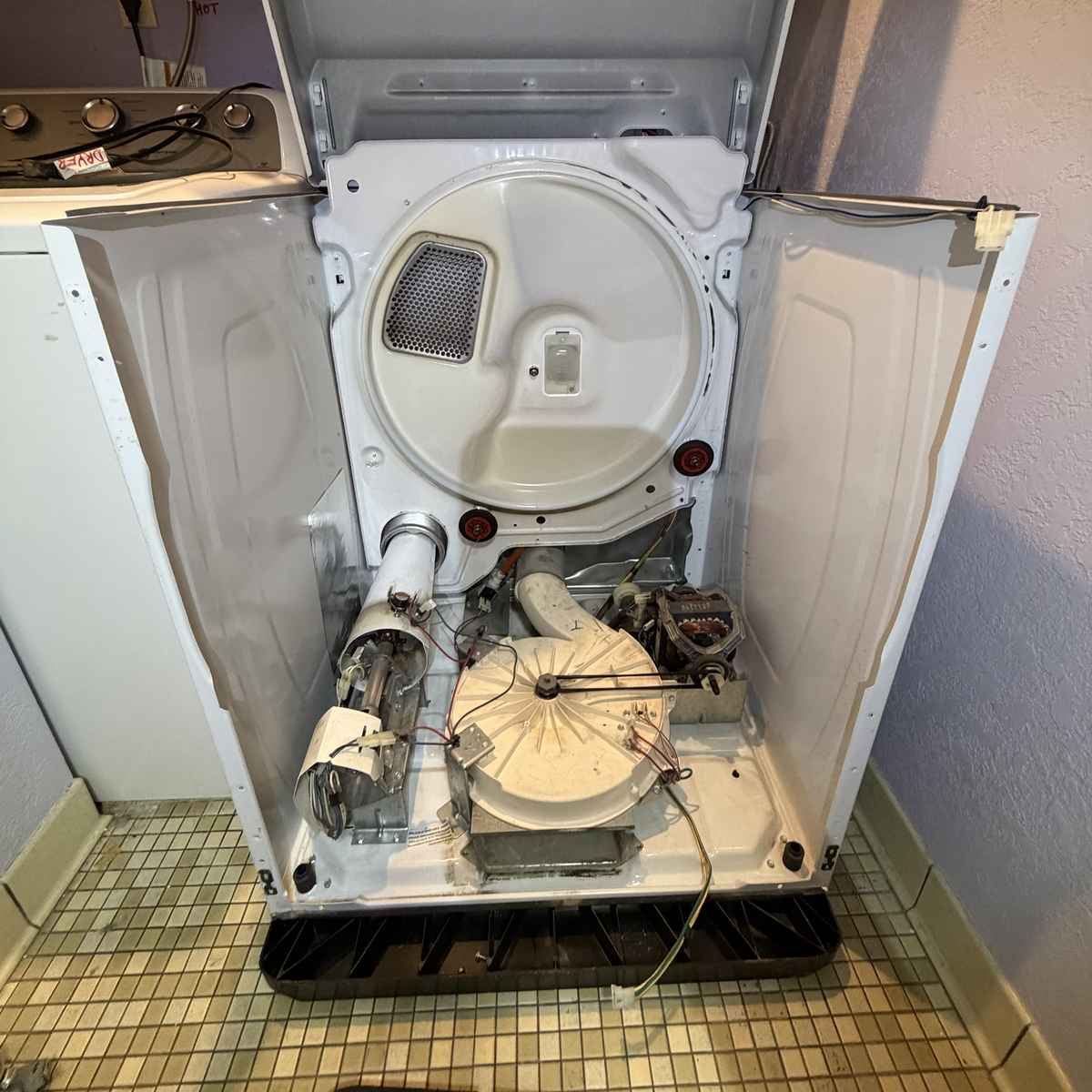
The thermal fuse is a one-time safety device, usually mounted on the blower housing or heater case. If the dryer overheats, the fuse blows and — on most models — kills the heat until it’s replaced. It costs a few dollars, but here’s what most DIY guides skip: a thermal fuse almost never blows for no reason. Something made the dryer overheat, and nine times out of ten that something is a lint-clogged vent (more below). Replace the fuse without fixing the cause and you’ll be replacing it again next month.
3. Burned-out heating element
The element is a long coil of resistance wire inside a metal housing. After years of heating and cooling, the coil breaks at its weakest point — an open circuit, no heat. Sometimes you can see the break; usually a continuity test finds it.
4. High-limit thermostat
This safety thermostat sits on the heater housing and cuts power to the element if things get too hot. It can fail open (no heat at all), and like the thermal fuse, repeated tripping points back at airflow.
5. Cycling thermostat
The cycling thermostat is the one doing the everyday work — switching the element on and off to hold drying temperature. Stuck open, it tells the dryer “we’re warm enough” forever, and the element never energizes.
6. Timer or control board
Least common, checked last: the timer contacts or the electronic control board can stop sending power to the heat circuit. This is a bench-level diagnosis — by this point you want a technician with a wiring diagram, not a parts cannon.
Gas dryer not heating: watch the igniter tell you the answer
A gas dryer heats through a short chain: the igniter glows orange-hot → the gas valve coils (small solenoids on the valve) open → the burner lights → the flame sensor confirms flame. When there’s no heat, the igniter’s behavior points at the broken link. Dim the lights, remove the small lower access panel if your model has one, start a heat cycle, and watch the burner area:
- Igniter glows, then shuts off — no flame ever appears: the classic sign of failed gas valve coils. The igniter called for gas; the solenoids never opened the valve. This is the most common gas no-heat failure, and coils are an inexpensive part for a technician to swap.
- Igniter never glows at all: the igniter has cracked (brittle ceramic, fails often), the flame sensor has failed open — on most designs it’s wired in series with the igniter, so a dead sensor stops the glow entirely — or the thermal fuse has blown. All three are quick continuity checks.
- Burner lights, then drops out and won’t relight: often weakening coils or a flame sensor giving up as parts heat up — heat for one load, cold the next.
- Nothing at all: check the obvious — the gas shutoff valve behind the dryer got bumped closed, or a propane tank ran empty.
Rather have a pro run these tests?
Same-day dryer service available across San Diego County when you call before noon — $90 service call, credited toward the repair.
The hidden root cause: your dryer vent
Here’s the pattern behind a huge share of no-heat calls, gas and electric alike. Lint slowly packs the vent duct. Airflow drops. Heat that should leave with the exhaust stays trapped in the drum. The high-limit thermostat trips, cycle after cycle, until one day the thermal fuse blows — and now the dryer runs cold. The fuse gets blamed; the vent was the criminal.
It’s also a genuine fire hazard, not just a repair nuisance. U.S. fire departments respond to an estimated 2,900 home dryer fires every year, and “failure to clean” is the leading contributing factor at about 34% of them, per the U.S. Fire Administration. Warning signs your vent is choking:
- Loads need two or three cycles to dry — and have for months.
- The top of the dryer and the laundry room get noticeably hot mid-cycle.
- A faint hot-lint or burning smell while it runs.
- Weak or no airflow at the outside vent flap while the dryer is on.
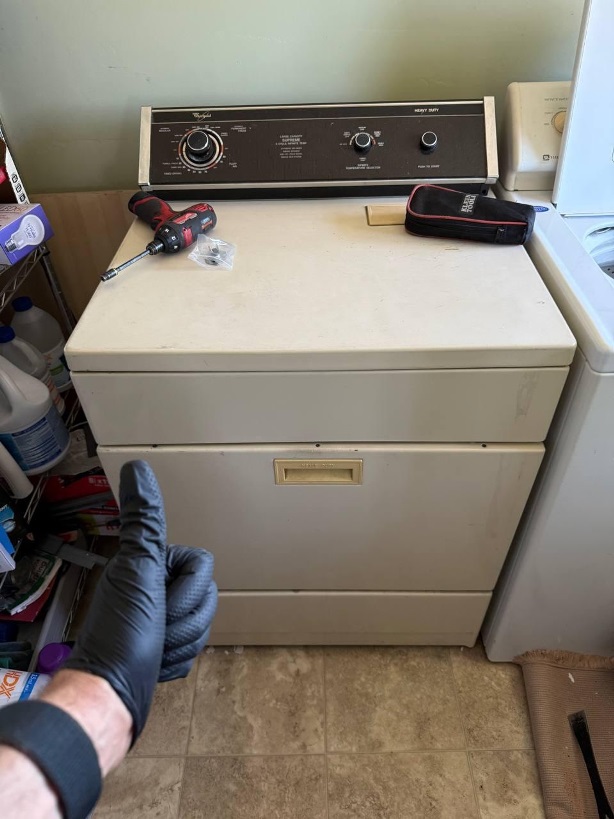
Quick test: run the dryer on air-dry and put your hand at the exterior vent hood. You should feel a strong, steady push of air and see the flap held open. A lazy trickle means a restricted duct. Whenever we replace a thermal fuse, we check the vent in the same visit — otherwise the repair is a countdown timer. And if the dryer shares a cramped closet with the washer, it’s worth checking both machines’ connections while everything is pulled out — our washing machine repair team sees the same closet issues from the other side.
Brand-specific quirks (the one-paragraph version)
This guide covers every brand, but a few patterns are worth a line each: Samsung electric dryers are known for heating-element failures (some models flash an hE code when the heat circuit faults); LG models often pair an element failure with a tripped high-limit thermostat, so both get checked together; and on Whirlpool, Maytag, and Kenmore machines the thermal fuse on the blower housing is the first stop. Samsung- and LG-specific no-heat diagnostics are getting their own dedicated guides — that’s where the brand deep dives live.
What it costs, and when to hand it off
Call a pro when the fix goes past the breaker reset and the lint screen: continuity testing, element or thermostat replacement, anything on the gas side, or a vent line that needs opening up. Guessing at parts gets expensive fast — an element bought on a hunch is money spent whether or not it was the problem.
Spark keeps it simple: our $90 service call fee is credited toward the repair when you go ahead with it. Most no-heat repairs — fuse, coils, element, thermostat — are same-visit jobs off the truck, and every one is backed by our 90-day warranty on parts and labor. Same-day service available across San Diego County when you call before noon.
Frequently Asked Questions
Why does my dryer run but not heat up?
Because the drum motor and the heat source are on separate circuits, one can fail while the other keeps working. On electric dryers the usual causes are one tripped leg of the 240-volt breaker, a blown thermal fuse, or a burned-out heating element. On gas dryers it’s most often the gas valve coils, the igniter, or the flame sensor.
How do I know if my dryer’s thermal fuse is blown?
Unplug the dryer, locate the fuse on the blower or heater housing, remove one wire, and test it with a multimeter on the continuity setting. A good fuse reads near zero ohms; a blown fuse reads open. If it is blown, have the vent checked too — overheating from a lint-clogged vent is the most common reason thermal fuses fail.
Why does my gas dryer igniter glow but no flame appears?
The igniter is calling for gas but the gas valve coils are not opening the valve — that glow-then-shutoff pattern with no flame is the classic sign of failed valve coils. It is one of the most common gas dryer repairs, and it is a job for a licensed technician since it involves the gas valve assembly.
Can a clogged vent really stop a dryer from heating?
Yes, indirectly. A lint-restricted vent traps heat inside the dryer, which trips the high-limit thermostat and eventually blows the thermal fuse — and then the dryer runs with no heat at all. It is also a fire risk: failure to clean is the leading factor in the roughly 2,900 home dryer fires U.S. fire departments see each year.
How much does it cost to fix a dryer that won’t heat in San Diego?
Spark charges a $90 service call fee that is credited toward the repair when you proceed. Common no-heat parts like thermal fuses, gas valve coils, and thermostats are inexpensive; a heating element costs more. Every repair comes with a 90-day warranty on parts and labor.
Is it safe to fix a gas dryer myself?
You can safely check the lint screen, the vent, and the gas shutoff valve position, and you can watch the igniter through the access panel. Do not disassemble the burner, gas valve, or coils yourself — gas-side repairs should be done by a licensed and insured technician. If you ever smell gas, close the shutoff valve, ventilate, and call from outside.
Cold clothes, warm drum? We’ll have it heating today
Skip the parts-guessing. Spark’s licensed and insured technicians repair gas and electric dryers from every major brand across San Diego County — $90 service call credited to your repair, 90-day warranty on parts and labor, and honest advice if replacement makes more sense than repair.