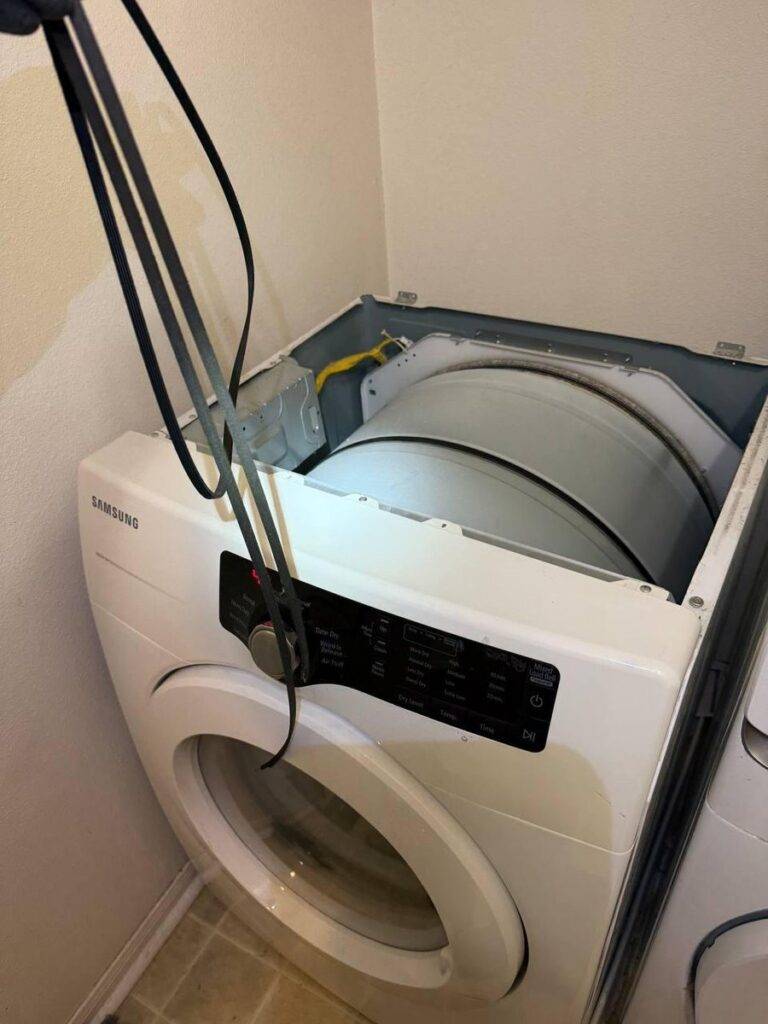
Five parts cause almost every Samsung no-heat call — check them in this order, cheapest and most likely first, and you won’t buy parts you don’t need.
Your Samsung dryer spins, the timer counts down, but the clothes come out cold and wet. This is one of the most common Samsung service calls we run in San Diego — and the cause is almost always one of five parts. The trick is checking them in the right order, from the cheapest and most likely to the most involved, so you don’t buy parts you don’t need.
This guide covers electric Samsung dryers step by step (that’s most of them), with a short section for gas models at the end. If you have a different brand, start with our general dryer not heating guide instead.
Jump to a step
BHeating elementStep 3: the 10–12 ohm test — and why Samsung coils sag
CThermostats & moisture sensorStep 4: cheap parts, quick continuity checks
DControl board & gas modelsStep 5 — last, not first
Before you start: two safety rules
- Unplug the dryer (or shut off its breaker) before removing any panel. An electric dryer circuit carries 240 volts — enough to cause serious injury.
- You’ll need a multimeter for most of these checks. A basic one costs about $15 at any hardware store and pays for itself on the first repair.
Step 1: Check the breaker and 240-volt supply
What it is: An electric Samsung dryer uses two 120-volt legs — one runs the motor and drum, the other powers the heater. If one leg drops out, you get the classic symptom: the dryer runs perfectly but produces zero heat.
How to check it: Find the dryer’s double (two-pole) breaker in your panel. Flip it fully OFF, then back ON — a half-tripped leg can look normal at a glance. Run a timed-dry cycle and check for heat after a few minutes.
What repair involves: If the breaker trips again, or resetting fixes it only temporarily, the breaker or outlet may be failing — that’s an electrician’s job, not a dryer part. Cost of this check: free.
Step 2: Test the thermal fuse (the #1 culprit)
What it is: Samsung mounts a one-time thermal fuse (part DC96-00887A, sold as the thermal fuse/high-limit kit) on the heater housing. If the heater box overheats — usually because of a lint-clogged vent — the fuse blows permanently and cuts power to the element. The dryer keeps tumbling; it just never heats again.
How to check it: Unplug the dryer and remove the rear access panel. The fuse sits on the heater housing with two wires. Pull the wires off and touch your multimeter probes to the terminals on a continuity setting. A good fuse beeps (continuity); a blown fuse reads open — no beep, no heat.
What replacement involves: Two spade connectors and one or two screws — a genuinely simple swap. The part runs about $10–$25. But here’s the part most homeowners miss: a thermal fuse never blows for no reason. Clean the vent duct from the dryer to the outside wall, or the new fuse will blow too.
Step 3: Test the heating element
What it is: The heart of the machine — Samsung’s heating element (the famous part DC47-00019A on many models) is a long coil of resistance wire suspended on a frame inside the heater box behind the rear panel.
How to check it: With the dryer unplugged and wires disconnected, measure resistance across the element’s two terminals. A healthy element reads roughly 10–12 ohms. A reading of infinity (open) means the coil has snapped — no heat at all. Then run a second test most guides skip: touch one probe to an element terminal and one to the bare metal housing. You should get no continuity. If you do, the element is grounded out — more on that below.
What replacement involves: Remove the rear panel, disconnect the wiring, unbolt the heater housing, and swap the element or the whole assembly. It’s a 45–90 minute job with basic tools. The element alone runs about $25–$80; smart money buys the kit that bundles the element with the thermal fuse and high-limit thermostat (DC47-00018A) for $70–$110, because these parts tend to fail together.
Why Samsung heating elements fail more often
Samsung uses an open-coil design: bare resistance wire zigzagged across a ceramic-insulated frame. Every cycle, that wire heats to glowing and cools back down, and over roughly 4–7 years of thermal cycling the coil stretches and starts to sag. Two things happen next:
- The coil snaps — a sagging section develops a hot spot and burns through. Result: no heat at all.
- The coil touches the metal housing — the element “grounds out.” Current now bypasses the control relay through the chassis, so the element can’t be switched off. The dryer runs scorching hot, may smell hot, can heat even on air-fluff, and often shuts itself down with an HC (or hE) overheat code.
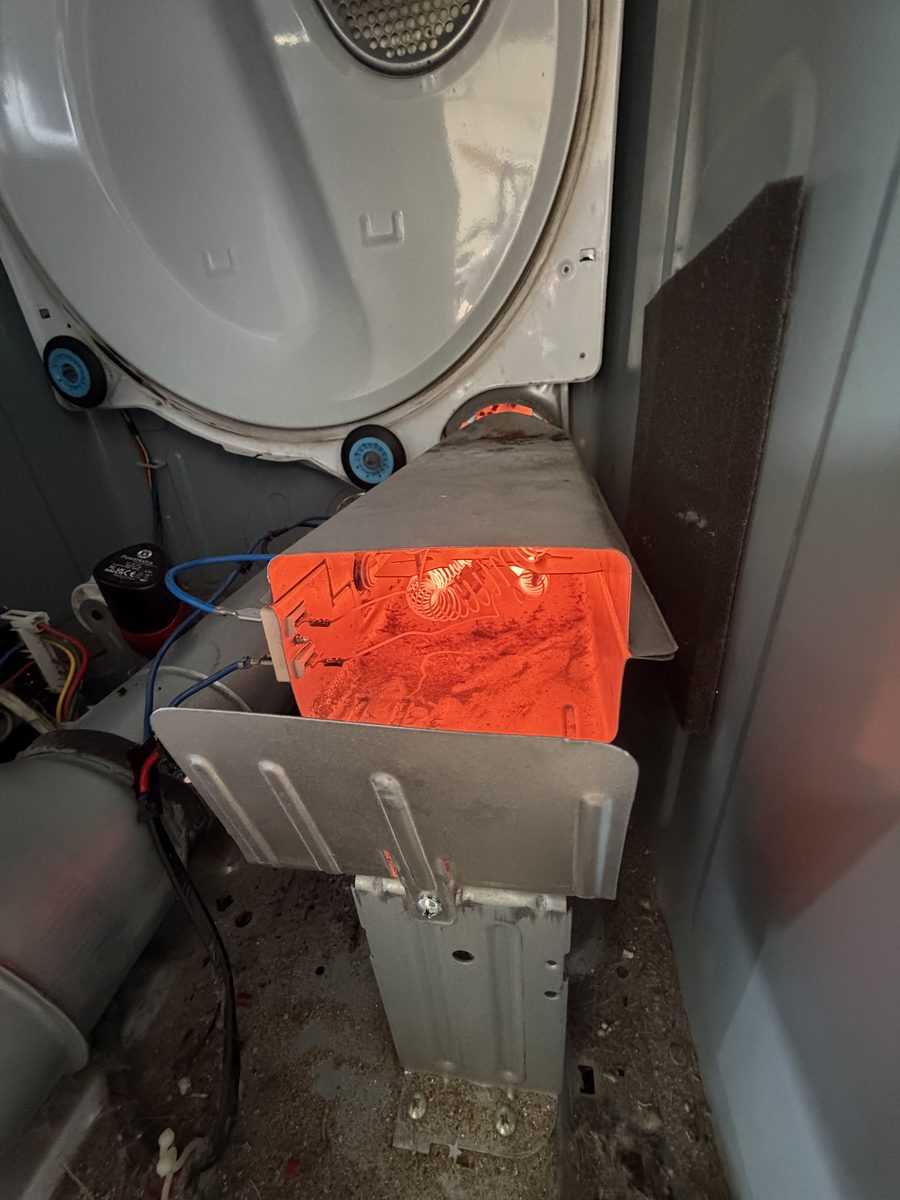
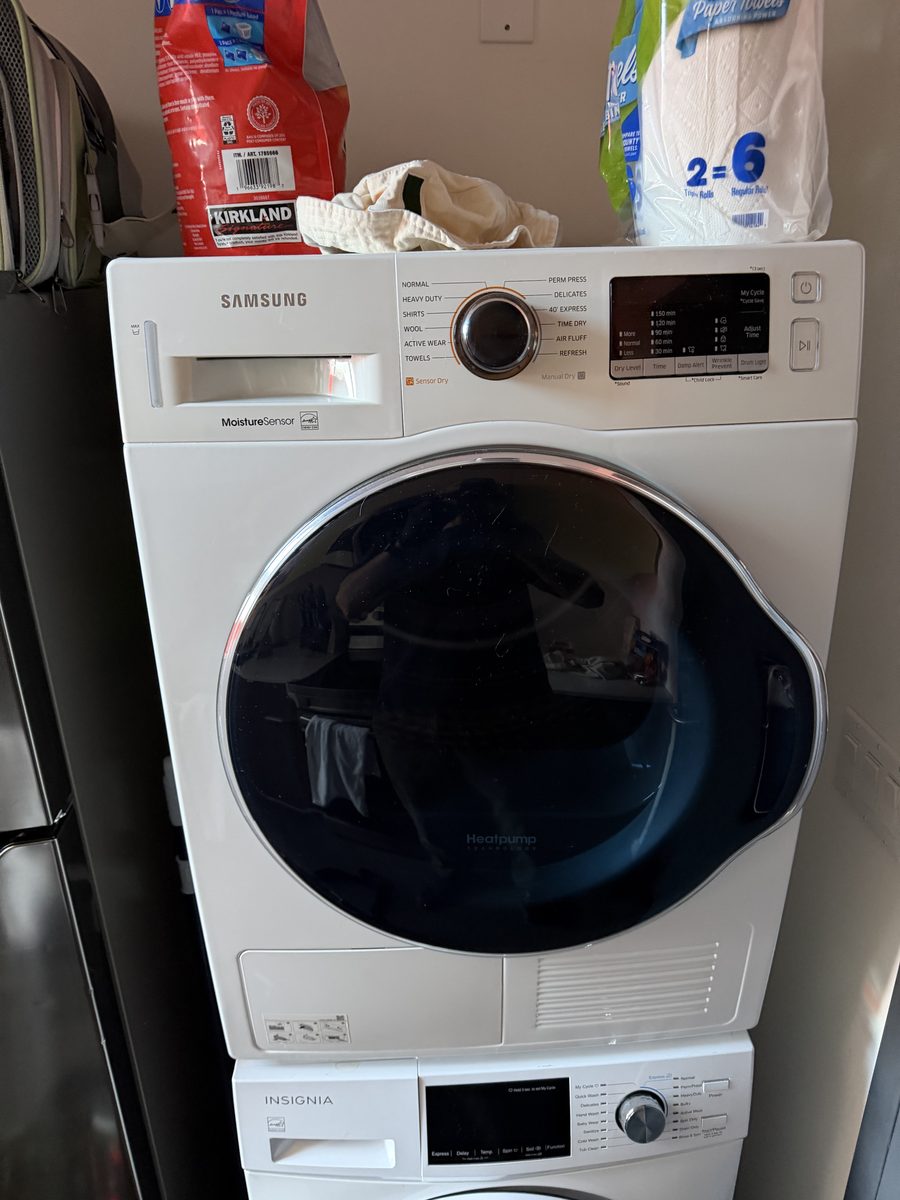
Element testing not your idea of a Saturday?
Call before noon for same-day Samsung dryer service anywhere in San Diego County. The $90 service call is credited toward your repair.
Step 4: Check the thermostats and moisture sensor
What they are: Alongside the thermal fuse, the heater circuit has a high-limit thermostat and a cycling thermostat/thermistor that regulate temperature. In the drum, two metal moisture-sensor bars tell the dryer when clothes are dry.
How to check them: Thermostats test just like the fuse — continuity across the terminals at room temperature; open means bad. Each runs about $10–$30. The moisture sensor causes a different but related complaint: the dryer heats fine but stops early with clothes still damp. Dryer-sheet residue coats the bars over time, so the sensor reads “dry” too soon. The fix is free: wipe the two bars inside the drum with rubbing alcohol on a cloth.
What replacement involves: Thermostats are simple two-wire swaps on the heater housing. A failed thermistor is slightly more involved but still an inexpensive part.
Step 5: The control board (last, not first)
What it is: The electronic board that switches the heater relay. It’s the least common cause on this list — which is exactly why it’s step 5, after everything cheaper has tested good.
How to check it: Honestly? By elimination. If the supply is good and the fuse, element, and thermostats all show correct readings, the board’s heater relay is the remaining suspect. There’s no safe homeowner test for a live board.
What replacement involves: Boards run $150–$250+ for the part, and misdiagnosing one is the most expensive mistake in dryer repair. This is the point where a professional diagnosis pays for itself — our $90 service call fee is credited toward the repair, so confirming the real fault costs you nothing extra when we fix it.
Have a gas Samsung dryer? Read this instead
Gas models (DVG-series) share the thermal fuse and thermostats above, but the heat comes from a burner, not an element. The usual suspects: the igniter glows but the gas never lights (failed gas-valve solenoid coils, replaced as a set), the igniter never glows at all (failed igniter, about $20–$50), or the flame sensor has lost continuity. The one safe homeowner check is watching through the lower access panel whether the igniter glows at the start of a cycle. Anything beyond that involves the gas line and burner assembly — leave it to a licensed and insured technician.
When to stop DIY and call a pro
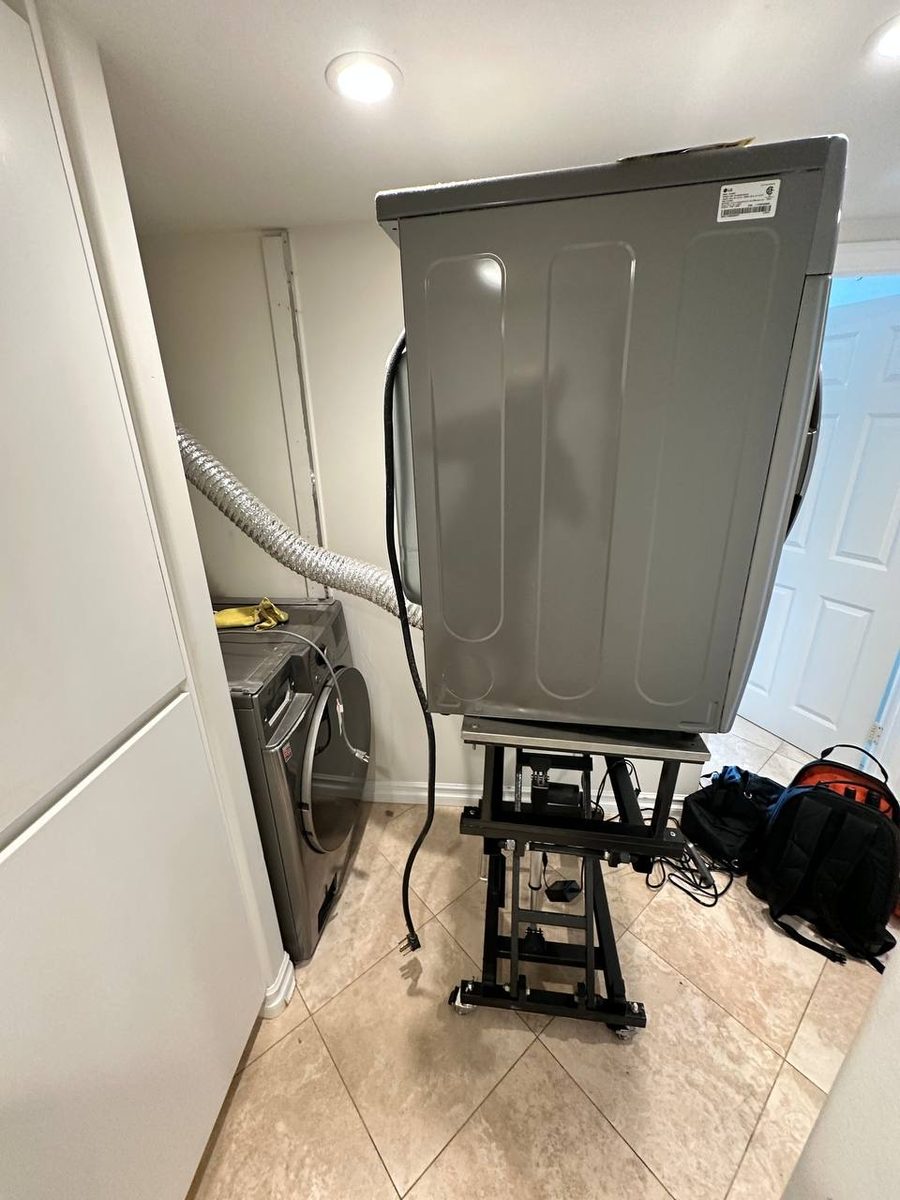
Call a technician if the element tests grounded, the board is the suspect, it’s a gas model, or you simply want it fixed today instead of next weekend. Spark repairs Samsung dryers across San Diego County — see our dryer repair service and Samsung appliance repair pages. Same-day service available when you call before noon, and every repair is backed by a 90-day warranty on parts and labor.
Frequently Asked Questions
Why is my Samsung dryer running but not heating?
The four most common causes, in order of likelihood: a blown thermal fuse on the heater housing, a failed heating element, a tripped leg on the 240-volt double breaker, and a bad high-limit thermostat. Check the breaker first because it’s free, then test the thermal fuse and element with a multimeter.
How do I know if my Samsung dryer heating element is bad?
Unplug the dryer, disconnect the element’s wires, and measure resistance across its terminals — a good element reads about 10 to 12 ohms. An open reading means the coil snapped. Also test from each terminal to the metal housing: any continuity there means the element is grounded out and must be replaced.
Why does my Samsung dryer heating element keep failing?
Samsung’s open-coil element sags with age and thermal cycling, and a restricted vent makes the coil run hotter and fail sooner. If you’ve replaced an element once already, have the vent line cleaned and the airflow checked — otherwise the new element will fail the same way.
How much does it cost to fix a Samsung dryer that won’t heat in San Diego?
Parts are inexpensive: a thermal fuse runs $10 to $25, a heating element $25 to $80, and a full element-fuse-thermostat kit $70 to $110. Spark charges a $90 service call fee that is credited toward the repair, and every job carries a 90-day warranty on parts and labor.
Why does my Samsung dryer heat but stop with clothes still damp?
That’s usually the moisture sensor, not the heater. Dryer-sheet residue films over the two metal sensor bars inside the drum, so the dryer thinks clothes are dry and ends the cycle early. Wipe the bars with rubbing alcohol; if that doesn’t help, the vent may be restricted.
How fast can Spark fix my Samsung dryer?
Same-day service is available across San Diego County when you call before noon. Our technicians are licensed and insured and stock common Samsung dryer parts on the van. Call (619) 330-5105 or book online.
Skip the multimeter — we’ll bring the parts
Our vans carry the common Samsung heating elements, fuse kits, and thermostats, so most no-heat repairs are done in one visit. The $90 service call fee is credited toward the repair, and you’re covered by our 90-day warranty on parts and labor.