A dryer’s real job isn’t making heat — it’s moving wet air out of your house. Choke that airflow anywhere and the same moisture keeps riding around the drum.
A healthy dryer finishes a full load in about 45 minutes. If yours needs two or three cycles, or the clothes come out warm but still damp, something specific is wrong — and it’s usually not the part people suspect. Here’s the mental shift that solves most of these calls: a dryer’s real job isn’t making heat. It’s moving wet air out of your house. Heat just loads the moisture into the air; the blower and vent have to carry it away. Choke that airflow anywhere along the path and the same moisture keeps riding around the drum, no matter how hot the machine runs.
Pick your symptom
BStops early, clothes still dampThe moisture-sensor story — when the dryer quits at 15 minutes
CLoads arrive soaking wetIt might be your washer — the most missed cause
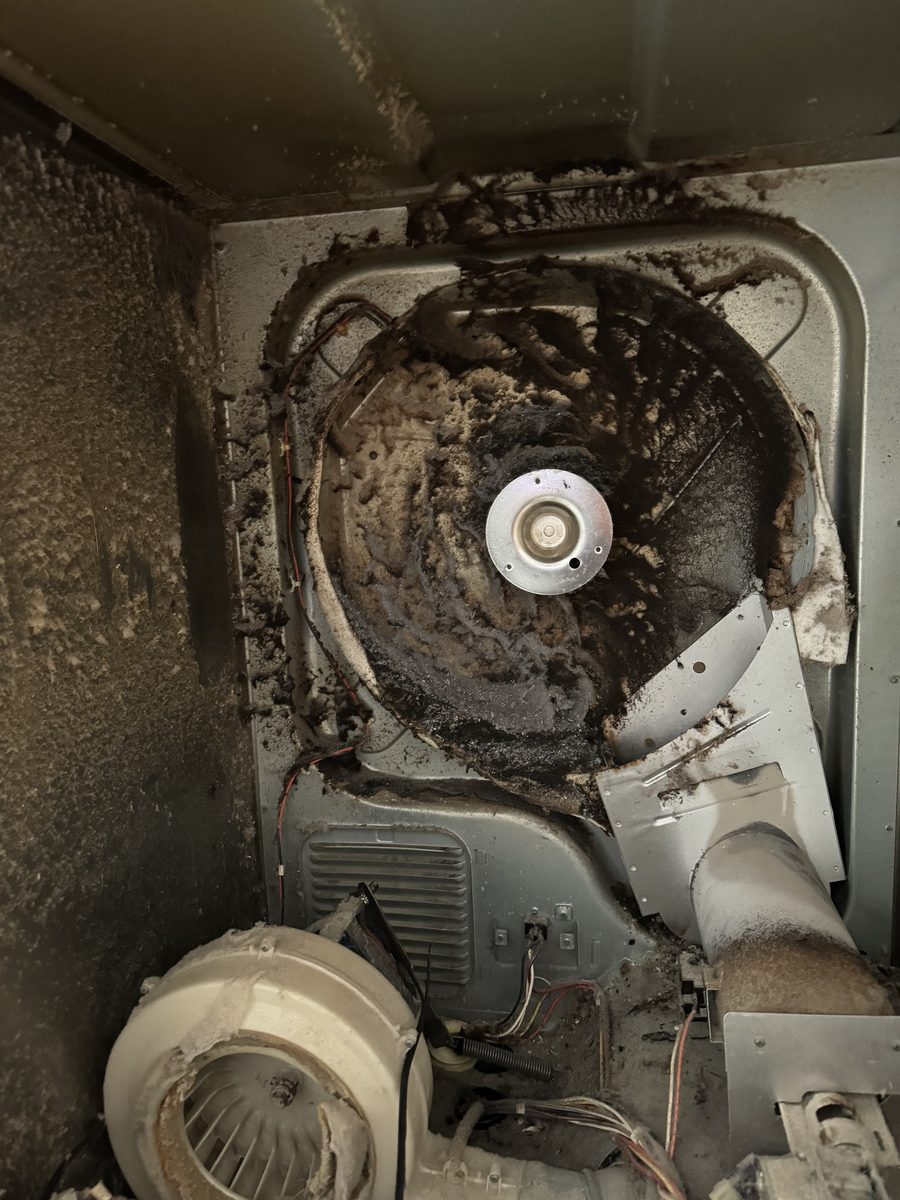
DWarm, but never hotWeak heat, and the fire risk behind chronic slow drying
Part 1: The 3-minute airflow audit
Restricted airflow is the number-one reason dryers dry slowly — a badly blocked vent can cut drying efficiency by as much as 80%. Before anyone talks about parts, run these three checks. They cost nothing and they catch the majority of slow-dry complaints.
Check 1: The lint-screen water test
Your lint screen can look spotless and still be the problem. Dryer sheets and liquid fabric softener leave an invisible film on the mesh that builds up over months and quietly strangles airflow. The test: pull the screen, hold it under the faucet, and watch what the water does. If it flows straight through, the screen is fine. If it beads up and pools on top, the mesh is sealed with softener residue. Scrub it with warm water, a drop of dish soap, and a soft brush, rinse until water passes freely, and let it dry completely before it goes back in.
Check 2: The outside flap
Go outside while the dryer is running and find the exhaust hood. The flap (or louvers) should be blown wide open with a strong, steady stream of warm, moist air behind it. A flap that barely lifts, flutters weakly, or is glued half-shut with lint tells you the duct between the dryer and this hood is packing up. While you’re there, make sure nothing is physically blocking the hood — a paint job, a pest screen matted with lint, or shrubs grown over the opening all do the same damage as a clog.
Check 3: The hose behind the dryer
Pull the dryer forward and look at the flexible transition hose connecting it to the wall. The two classic failures: the hose got crushed flat when the dryer was pushed back against the wall, or it has sagged into loops where lint and condensation collect. Foil accordion-style hoses are the worst offenders — every ridge catches lint. If yours is kinked, crushed, or heavy with buildup, replacing it with a short, smooth run is one of the cheapest performance upgrades a dryer can get.
One more airflow factor you can’t see from the laundry room: the duct run itself. Every foot of duct and every 90-degree elbow between your dryer and the outside wall adds resistance, and San Diego condos and garage conversions often route ducts far longer than the machine was designed to push. If your dryer has always been slow — not gradually got slower — a long, elbow-heavy duct run is a prime suspect, and it’s something we evaluate on a service visit.
Part 2: The moisture-sensor story — when the dryer quits early
Different symptom, same complaint: the dryer doesn’t run long — it stops after 15 or 20 minutes and declares the load done while everything inside is still damp. That’s not an airflow problem. That’s the moisture sensor being lied to.
On any “sensor dry” or automatic cycle, two thin metal bars inside the drum (usually just below the door, near the lint screen housing) read moisture by touch: wet fabric brushing across them conducts a small current, telling the control “still wet, keep going.” The same softener-and-dryer-sheet residue that films over your lint screen also coats these bars with a waxy, invisible layer — and wax is an insulator. Coated bars can’t feel the wet clothes touching them, so the control concludes the load is dry and shuts down early.
The fix takes one minute: unplug the dryer, dampen a cloth or cotton pad with rubbing alcohol, and scrub the metal bars firmly for 30–60 seconds. You won’t see much come off, but you’ll feel the surface go from slightly tacky to slick. If you use dryer sheets regularly, make this a monthly habit.
Here’s the tell that confirms the diagnosis: timed dry works fine, sensor cycles don’t. A timed cycle ignores the sensor completely and just runs the clock, so dirty bars can’t cut it short. If you’ve been quietly working around the problem by switching to timed dry, you’ve already proven the sensor is the issue — you’ve just been masking it instead of wiping it clean.
Done with the free checks and still damp?
Same-day dryer service across San Diego County — call before noon. $90 service call, credited toward the repair.
Part 3: It might be your washer
This one surprises people, but we see it every week: the dryer gets blamed for a job the washer failed to do. A dryer is designed to finish clothes that arrive damp — spun down to roughly half their soaked weight. If the washer’s spin cycle is weak, the load arrives sopping, and even a perfectly healthy dryer will need double time to evaporate all that extra water.
The test is simple: when you move laundry over, does it drip? Can you wring water out of a towel by hand? Clothes should come out of the washer damp-dry, not wet. If they don’t, the slow-dry problem lives on the other machine — common causes are a partly clogged drain hose, worn suspension letting the tub go off-balance at high speed, excess suds from too much (or non-HE) detergent, or a failing drain pump. That’s washer territory; our washing machine repair team handles it, and it’s worth checking before anyone opens up the dryer.
Two habits mimic the same symptom with both machines healthy: overloading (a stuffed drum leaves no room for air to move between items, so the middle of the load stays wet) and mixed loads (a sensor cycle ends when the light items read dry, leaving the towels and jeans damp). Dry heavy and light fabrics separately and keep the drum around two-thirds full.
Part 4: Weak heat — warm, but never hot
If airflow checks out, the sensor bars are clean, and the load arrives properly spun, the remaining suspect is heat output that’s reduced rather than gone. On an electric dryer, the heating element is a long coil of resistance wire — and it doesn’t always fail all-or-nothing. A section of coil can short against the housing or a segment can burn out, leaving the element producing partial heat: the exhaust feels warm instead of hot, and drying stretches toward two hours. On gas dryers, aging gas valve coils can weaken before they fail outright — the burner lights, drops out early, or fires on some cycles and not others, so the dryer averages far less heat than it should.
Both of these are meter-and-observe diagnoses, not guesses — and they sit on the same components covered in depth in our dryer not heating guide. The practical line for a homeowner: airflow, lint screen, sensor bars, and washer spin are your checks; anything involving the element, gas valve, or thermostats is where a technician with a multimeter earns the visit.
Part 5: When slow drying is a fire risk building
Brand notes, briefly
This is a pan-brand problem, so one paragraph covers the quirks: LG’s Flow Sense indicator (a d80-series code) is actually useful here — it estimates how blocked your duct is, so don’t ignore it. Samsung sensor-dry cycles are especially sensitive to filmed-over sensor bars, so the alcohol wipe pays off fast on those models. And on Whirlpool, Maytag, and Kenmore machines with rear-mounted lint screens, softener film builds up out of sight — the water test matters even more when you can’t easily eyeball the mesh.
What it costs, and when to hand it off
Call a pro when the free checks don’t move the needle: the flap test shows weak airflow after you’ve cleaned the screen and hose, the duct run needs opening up, or the heat itself is weak. Spark keeps the math simple — our $90 service call fee is credited toward the repair when you go ahead with it, so the diagnosis effectively costs nothing if we do the work. Vent cleanings, element replacements, and sensor repairs are typically same-visit jobs, and every repair is backed by our 90-day warranty on parts and labor. Same-day service available across San Diego County when you call before noon.
Frequently Asked Questions
Why does my dryer take two or three cycles to dry a load?
Almost always restricted airflow. The dryer is making heat, but moist air can’t leave fast enough, so the same moisture keeps circulating in the drum. Check the lint screen for invisible softener film with the water test, feel for strong airflow at the outside vent flap, and look for a crushed or lint-packed hose behind the dryer. If those don’t solve it, the duct run itself likely needs professional cleaning.
Why does my dryer stop while the clothes are still damp?
On sensor-dry cycles, filmed-over moisture sensor bars are the usual cause. Residue from dryer sheets and fabric softener insulates the two metal bars inside the drum, so wet clothes can’t register — the dryer thinks the load is dry and shuts off early. Unplug the dryer and scrub the bars with a cloth and rubbing alcohol for 30–60 seconds. If timed dry works fine but sensor cycles quit early, that confirms it.
How long should a dryer take to dry a full load?
About 45 minutes for a typical full load on a normal setting, assuming the washer spun the clothes out properly. If a normal load consistently takes more than an hour after you’ve cleaned the lint screen and checked the vent, something is wrong — restricted ductwork, a weak heating element, or a sensor problem — and it’s worth a professional diagnosis.
Can dryer sheets really cause a dryer to stop drying?
Yes, in two ways. They deposit an invisible waxy film on the lint screen that blocks airflow — if water beads up on the screen instead of flowing through, that’s the film. The same residue coats the moisture sensor bars, making the dryer end sensor cycles while clothes are still damp. Washing the screen and wiping the bars with rubbing alcohol fixes both.
Could my washer be the reason the dryer takes so long?
Yes — this is one of the most missed causes. If the washer’s spin cycle is weak, clothes arrive at the dryer soaked instead of damp, and even a healthy dryer needs double time. If laundry drips when you transfer it or you can wring water out by hand, the problem is the washer’s spin — a drain restriction, suds buildup, or a failing pump — not the dryer.
How much does it cost to fix a dryer that isn’t drying in San Diego?
Spark charges a $90 service call fee that is credited toward the repair when you proceed. Many slow-dry fixes — vent cleaning, a new transition hose, sensor service — are inexpensive same-visit jobs; a heating element costs more. Every repair is backed by a 90-day warranty on parts and labor, and same-day service is available when you call before noon at (619) 330-5105.
Two cycles per load is not normal — let’s fix it today
Stop paying double for every load. Spark repairs slow-drying gas and electric dryers from every major brand across San Diego County — $90 service call credited to your repair, 90-day warranty on parts and labor, and a straight answer if a vent cleaning is all you actually need.